UNO Basics: Core Rules at a Glance
This explains the general UNO card game rules, not any MT-specific version. If the PLAY777 version differs, follow the in-game rules. It covers the basics of playing, drawing, saying UNO, and scoring, with examples you can check against.
Confirm These Are General UNO Rules
The basic UNO structure is simple: each player starts with 7 cards, the rest form the draw pile, and the top card is turned over to begin the discard pile. On your turn, you usually play a card that matches the top discard by color, number, or symbol. This is the classic general version, not a platform-specific variant.
If UNO on PLAY777 has interface differences, table rules, or different version settings, follow the rules shown in the game. It is safer to understand the general flow first and then check the actual screen before you play.
- Each player starts with 7 cards.
- Set up the draw pile and discard pile first.
- You can treat it as general UNO to begin with.
How to Play on Your Turn
When it is your turn, check the color, number, and symbol of the top discard card. If any one of those matches a card in your hand, you can usually play that card. If you have no playable card, you must draw 1 card. Whether you can play the drawn card right away still depends on the current version and the on-screen prompt.
Beginners often miss one thing: UNO is not only about matching numbers. Color and symbol can also make a card playable. In other words, if the top card is red 5, you do not only need a 5; you may also play another red card. If it is a special action card, its effect also matters.
- Check color, number, and symbol first.
- If you have no playable card, draw 1 card.
- Special card effects depend on the current rules.
How the Basic Action Cards Work
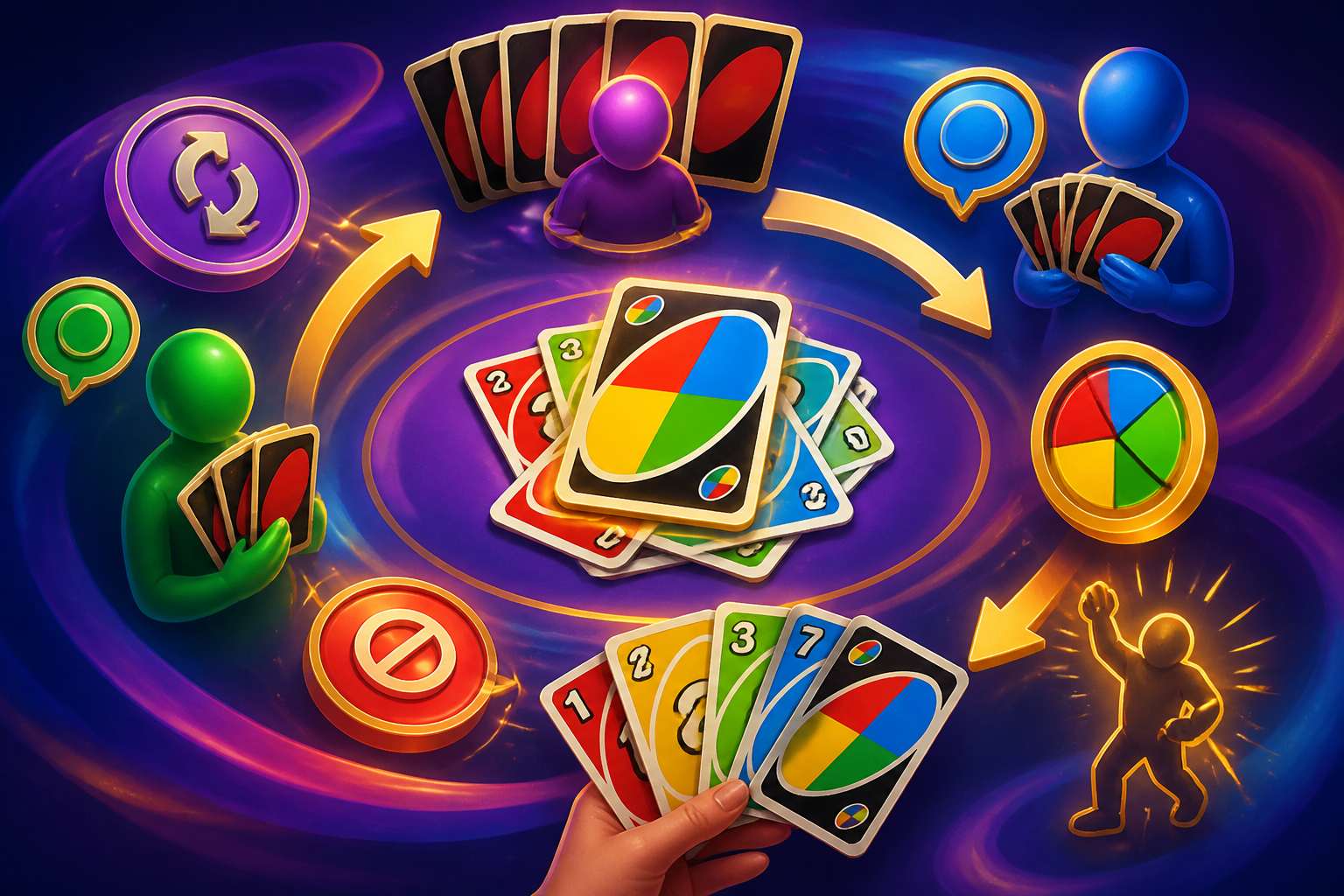
The classic basic action cards are Skip, Reverse, Draw Two, Wild, and Wild Draw Four. Skip makes the next player lose their turn. Reverse changes the direction of play. Draw Two makes the next player draw 2 cards and lose their turn. Wild lets you choose the next color. Wild Draw Four lets you choose the color, and the next player draws 4 cards and loses their turn. These are the confirmed basic effects, but some versions may add extra cards or house rules.
For most players, the key is to separate three ideas: changing direction, changing color, and forcing another player to draw cards. Once you can tell those apart, special cards are much easier to understand.
- Skip: the next player misses a turn.
- Reverse: changes direction.
- Draw Two: the next player draws 2 cards.
- Wild: choose the next color.
- Wild Draw Four: choose a color and make the next player draw 4 cards.
Saying UNO and Scoring
When you have 1 card left, you must say UNO. This is part of the basic rules and is meant to warn the other players that you are close to finishing. If you forget to say it, the exact penalty still depends on the version you are playing, so the safest choice is to follow the in-game rules.
For scoring, general UNO awards points based on the cards left in the other players’ hands. Number cards score their face value. Skip, Reverse, and Draw Two are usually 20 points each. Wild and Wild Draw Four are usually 50 points each. These are the classic base scoring values and can help you understand the game, but if your version is different, follow that version’s rules.
- Say UNO when you have 1 card left.
- Scoring usually uses the cards left in the other players’ hands.
- Number cards score by face value, and action cards have fixed values.
A Checkable Example
For example, if the top discard is red 5, and you have a red 2, a blue 5, or any other red card, you can usually play one of them. If you only have a green 9 and a yellow Skip, and nothing matches, you must draw 1 card. This example is easy to check: red matches red, 5 matches 5, and anything else that does not match means you draw.
Here is another scoring example: if you finish your hand first and the other players still have cards worth 8, 20, and 50 points, the round score is the sum of those remaining cards. Whether the total game target is 500 points depends on the version; if your version differs, follow the in-game rules.
- Red 5 can match a red card or a 5.
- If you cannot play, draw 1 card.
- Round points come from the total value of the other players’ remaining cards.
What New Players Should Do First
When you play for the first time, remember just three things: whether you can play depends on color, number, or symbol; if you cannot play, draw 1 card; and when you have 1 card left, say UNO. Practice these three steps first, then learn the special cards and scoring, and the game will be easier to pick up.
If you are seeing UNO on PLAY777, it is a good idea to check the in-game rules before each round, especially for house rules, version differences, or extra action cards. That helps avoid assuming another common version is the same as this one.
- First learn the play conditions.
- Then learn drawing and saying UNO.
- Follow the in-game rules for version differences.
Frequently asked questions
When playing UNO, do I always need to match both color and number?
No. Under the general basic rules, matching any one of color, number, or symbol is enough.
What should I do if I have no playable card?
Draw 1 card. Whether you can play it immediately still depends on the current version’s rules.
What action cards are in UNO?
The classic basic action cards are Skip, Reverse, Draw Two, Wild, and Wild Draw Four.
Is UNO on PLAY777 always exactly the same as everywhere else?
Not necessarily. This article explains the general basic rules only. For the actual table rules, follow the in-game rules.
Prepared and translated with AI assistance. Versions, offer conditions and interfaces may differ. Refer to the in-game help and member page.